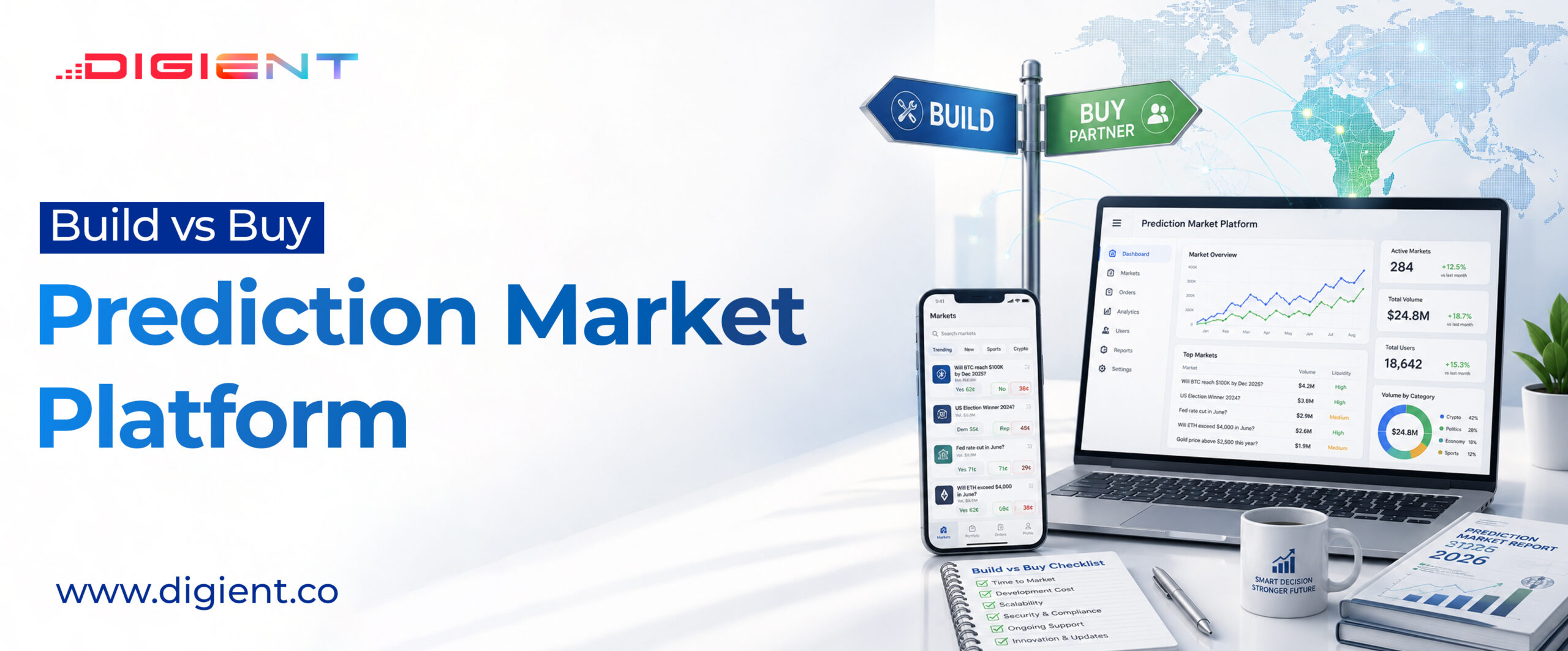
The US Prediction Market Opportunity in 2026
The US prediction market landscape has shifted dramatically since the CFTC granted Kalshi its landmark legal approval. State-by-state sports betting legalisation, combined with growing retail appetite for event-contract trading, has created a commercially viable window that did not meaningfully exist three years ago.
Operators who once dismissed prediction markets as a regulatory grey zone are now treating them as a serious revenue vertical. The question on every boardroom agenda is no longer whether to enter. It is how fast, and at what cost.
This growth is not happening in isolation. Operators entering prediction markets must compete with established exchanges and sportsbooks that have already invested millions in compliance infrastructure, risk engines, and liquidity management. A slow or underfunded build strategy hands first-mover advantage directly to competitors.
What a Compliant Platform Actually Requires
Before you price either path, you need a clear-eyed picture of what a production-ready prediction market platform includes. Most operators significantly underestimate scope, particularly on the regulatory and infrastructure side.
Core Technical Requirements
- ✦Market creation and settlement engine: logic for creating event contracts, managing outcomes, and settling positions accurately across multiple market types.
- ✦Order book or parimutuel matching: a real-time matching engine capable of handling concurrent positions without latency spikes during high-traffic events.
- ✦Wallet and transaction ledger: user balance management, deposits, withdrawals, and a tamper-evident audit trail for every financial event.
- ✦Risk and odds management: automated exposure limits, liability controls, and market-maker integrations to maintain liquidity.
- ✦KYC/AML compliance layer: identity verification, sanctions screening, and transaction monitoring as required under FinCEN and state-level mandates.
Regulatory and Compliance Requirements
- ✦Geolocation and access controls: real-time location verification to block users in restricted states, compliant with UIGEA requirements.
- ✦Responsible gambling tools: deposit limits, self-exclusion, reality checks, and integration with NCPG's GAMBAN and state exclusion lists.
- ✦Data security infrastructure: SOC 2 compliance, encryption at rest and in transit, and penetration-tested architecture.
- ✦State-level licensing integrations: reporting APIs and audit log formats specific to each jurisdiction where you operate.
The True Cost of Building from Scratch
Building a prediction market platform entirely in-house, from architecture through to compliant launch, is one of the most capital-intensive moves in iGaming. When you account for engineering, product, compliance, infrastructure, legal, and the inevitable delays, the all-in cost routinely crosses $2 million before a single player places their first prediction. Here is how that number breaks down.
| Cost Item | Estimated Cost | Notes |
|---|---|---|
| Core engineering team (8–12 FTEs) | $720,000 – $960,000 | Backend, frontend, mobile, DevOps; US or nearshore rates across 14–18 months |
| Product and UX design | $80,000 – $140,000 | Discovery, prototyping, design systems, and iterative refinement |
| Legal and regulatory counsel | $150,000 – $250,000 | State licensing applications, CFTC filings, compliance frameworks, and ongoing legal retainer |
| KYC/AML vendor integration | $30,000 – $60,000 | Integration engineering plus first-year transaction volume costs |
| Payment processing and banking setup | $30,000 – $60,000 | Integration, reserve requirements, compliance onboarding with processors |
| Infrastructure and hosting | $50,000 – $90,000 | Multi-region cloud, CDN, failover architecture, and penetration testing |
| Data feed and odds subscriptions | $40,000 – $80,000 | Sports data APIs, real-time odds feeds, settlement data providers |
| QA, security audits, and pen testing | $50,000 – $100,000 | Third-party audits mandated by most US state regulators before licence approval |
| Project management and operations | $80,000 – $120,000 | PMs, BAs, scrum overhead across the full build cycle |
| Contingency and overrun (typical) | $100,000 – $200,000 | Regulatory delays, scope changes, and rework are routine on first-time iGaming builds |
| Total Estimated Cost to Build In-House | ~$2,000,000 | Before marketing spend, liquidity provisioning, or state licence fees |
The Build Timeline Reality
Hiring, technology decisions, vendor procurement, regulatory strategy. Revenue: zero.
Market engine, wallet, matching logic, admin tools. First internal alpha possible by month 7–8.
KYC/AML, geolocation, responsible gambling tooling, security audits, state applications.
Load testing, regulatory sign-off, first customer cohort. Commercial launch at earliest.
The Real Cost of a Turnkey Platform
With Digient, you get a fully custom prediction market platform, built and configured to your brand, for a one-time setup fee of $40,000. That covers everything needed to go live: platform configuration, front-end branding, payment gateway integration, compliance tooling setup, and initial UAT. From there, we operate on a revenue share model, so our incentives are directly tied to your growth. No bloated licence fees. No engineering headcount on your payroll.
| Build In-House | Digient Turnkey | |
|---|---|---|
| Upfront cost to launch | ~$2,000,000 | $40,000 |
| Time to market | 14–18 months | 8–12 weeks |
| Engineering team required | 8–12 FTEs ($720K–$960K/yr) | None |
| Platform development | From scratch | Production-ready, fully configured |
| Front-end branding | Included in build cost | Included in $40K setup |
| Compliance tooling | Built and maintained in-house | Included and maintained by Digient |
| Ongoing cost model | Fixed salaries + infrastructure (~$200K–$400K/yr) | Revenue share only (aligned to your GGR) |
| Revenue generating from | Month 15–18 at earliest | Week 12 or sooner |
| IP and customisation | Full ownership | Custom-branded; scalable with your growth |
| Risk | Operator bears all technical and cost risk | Shared model; Digient succeeds when you do |
| Year 1 total (excl. marketing) | ~$2,000,000+ | From $40,000 + rev share |
The headline advantage of a turnkey approach is not just cost reduction: it is risk transfer. The platform provider bears the technical debt, security obligations, and ongoing compliance update burden. Your team focuses on acquisition, retention, and brand differentiation, not on engineering or infrastructure.
Operators who choose turnkey solutions consistently reach break-even faster, not because costs are lower in absolute terms, but because revenue starts earlier. Rather than absorbing 18 months of pre-revenue burn against a $2 million spend, a Digient operator is live in market and generating GGR within the first quarter, with a total upfront commitment of $40,000.
When Building Makes Sense (And When It Does Not)
Despite the cost and timeline arguments, building from scratch is the right choice for certain operators. The decision depends on factors that no external benchmark can fully resolve.
Build if...
- ✦You have a genuinely novel market mechanic or product thesis that no existing platform can replicate.
- ✦You have deep iGaming engineering experience in-house and have priced the full build realistically.
- ✦You have secured Series A+ funding and can sustain 18–24 months of pre-revenue burn without existential pressure.
- ✦Your long-term strategy requires full IP ownership and you are building a platform business, not just an operator.
Choose a turnkey platform if...
- ✦Your competitive advantage is brand, distribution, or existing player relationships, not proprietary technology.
- ✦You need to be live within a regulatory window that a custom build cannot meet.
- ✦You are entering a new vertical (prediction markets) from an adjacent one (sportsbook, poker, exchange) and need to validate demand before major capital deployment.
- ✦Your team has strong commercial expertise but limited iGaming-specific engineering depth.
The US prediction market sector rewards operators who move quickly with credible product. Speed to market, underpinned by solid compliance, consistently outweighs technical elegance in the early-adoption phase of a regulated vertical.
How Digient Accelerates Your Launch
Digient has delivered more than 200 iGaming platforms across Asian, European, and emerging regulated markets over 18 years of operation. Our turnkey frameworks are purpose-built for operators who need proven, production-ready infrastructure without the multi-million-dollar custom build burden.
Our prediction market and gaming platform stack includes a fully configurable market creation and settlement engine, multi-jurisdiction compliance modules, real-time risk management, and player CRM integrations. Operators launching on Digient's infrastructure benefit from the same compliance tooling and vendor relationships we have developed across our entire client base, without the negotiation overhead of starting from scratch.
What a Digient-Powered Launch Looks Like
Licensing model, revenue share, custom module requirements, and compliance framework confirmed.
Brand skin, market categories, payment gateway integration, KYC vendor connection.
Regulatory documentation, geolocation testing, responsible gambling tool validation, QA sign-off.
First cohort onboarded, operations team trained, monitoring and support escalation paths live.
Frequently Asked Questions
Launch with Digient
Stop Calculating. Start Building.
Building in-house costs around $2 million and takes 18 months. Digient gets you live with a fully custom prediction market platform for $40,000, then we grow on revenue share together. One call with our platform team is all it takes to see the difference.