
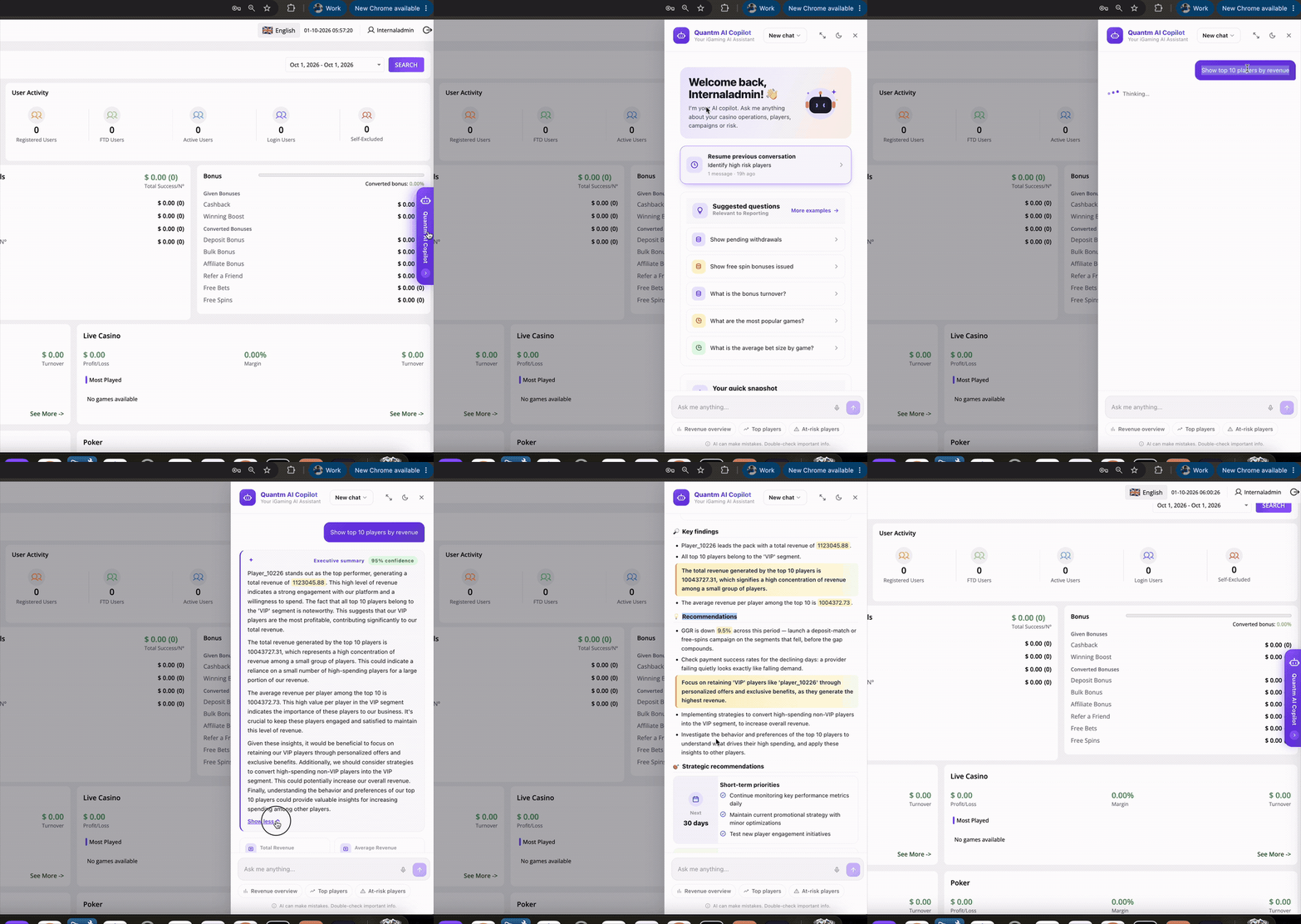
Your revenue report shows a quieter week. Some previously active players have stopped returning. A campaign continues generating conversions, but its cost keeps rising.
The figures are available. The challenge is deciding what they mean and what to do next.
Predictive analytics in iGaming helps operators look beyond historical performance to estimate likely outcomes. It can support earlier investigation, more informed planning and better questions about retention, spending and operational demand.
Digient Technologies brings this approach into Quantm AI, its AI-enabled iGaming platform. Quantm AI Copilot combines reporting, forecasting and recommendations within the back office, using the operator's own data.
For operators, the value lies in connecting an insight to a decision while there is still time to act.
What Is Predictive Analytics in iGaming
Predictive analytics uses historical data, statistical methods and machine learning to estimate future outcomes. It identifies patterns that help businesses assess what is likely to happen next.
In an iGaming operation, relevant inputs might include session frequency, deposit history, wagering activity, campaign responses and daily revenue.
For example, a player who previously returned regularly may begin visiting less often. That change could indicate a higher likelihood of inactivity. However, it could also reflect travel, changing interests or a deliberate break.
Predictive player analytics can help prioritise a closer look. It cannot establish the reason for that behaviour by itself.
A prediction is an estimate. A revenue forecast presents a likely outcome within a range. It does not promise that tomorrow's performance will match a single projected figure.
How Predictive Analytics Differs From Traditional Reporting
Traditional reporting and predictive analytics answer different questions. Operators need both to understand performance and plan their response.
| Approach | Question | Operator use | Example decision |
|---|---|---|---|
| Traditional reporting | What happened? | Review recorded performance | Investigate a decline in deposits |
| Predictive analytics | What might happen next? | Assess likely outcomes and uncertainty | Prepare for a quieter revenue period |
| Recommendations | What action should we consider? | Evaluate options against business rules | Review spending before committing more budget |
A report may show that revenue has declined. A forecast can help assess whether the recent pattern is likely to continue. A recommendation can suggest an action for the team to evaluate.
These are separate steps. A useful recommendation still needs an owner, an appropriate review and a way to measure the outcome.
Where Predictive Insights Can Support Operator Decisions
Quantm AI Copilot supports revenue forecasting, churn scoring, player value bands and risk analysis. Their operational usefulness depends on available data and the circumstances behind each result.
Identifying Possible Player Churn Earlier
Churn scoring considers activity decline, time since last play and changes in deposits.
Rather than examining every account manually, a retention team can use a ranked list to identify accounts that warrant attention. Player retention analytics can make that review more focused.
Reduced activity is not automatically a reason to send a promotion. Teams should first consider service issues, communication preferences, account restrictions and responsible gaming concerns.
A player taking a voluntary break should not be treated in the same way as someone experiencing a payment problem.
Making More Informed Campaign Decisions
High conversion does not necessarily mean a campaign is commercially worthwhile.
Quantm AI Copilot's campaign analysis places conversion, GGR and campaign cost alongside each other. This gives operators more context than a response rate alone.
GGR, or gross gaming revenue, generally represents stakes less winnings, before other business costs. Campaign evaluation needs clear definitions of which costs are included.
This analysis can inform targeting and budget reviews. Predicting individual campaign response is a broader potential use case that should be confirmed separately.
Teams should check player eligibility and communication permissions before acting on any recommendation.
Planning for Changes in Demand
Daily GGR forecasts display uncertainty ranges and draw on weekly patterns in historical performance.
Those forecasts can inform discussions about bonus exposure, staffing and financial planning. Operators can examine a lower-revenue scenario before committing spending.
Revenue is not the same as demand. A sportsbook may process heavy activity without a proportional increase in GGR. Forecasting support tickets, concurrent users or transaction volumes requires relevant inputs and separately verified capabilities.
Major fixtures, poker tournaments and lottery draws also need context beyond an ordinary weekly pattern.
Understanding Player Value Responsibly
Grouping accounts into estimated lifetime-value bands can support planning and help teams understand how revenue is distributed across their player base.
These estimates remain uncertain. Future contribution can change with preferences, market conditions and account behaviour. It is important to distinguish gross revenue from contribution after bonuses and service costs.
An estimated value band should never override responsible gaming controls or justify encouraging unsuitable play.
Prioritising Unusual Patterns for Review
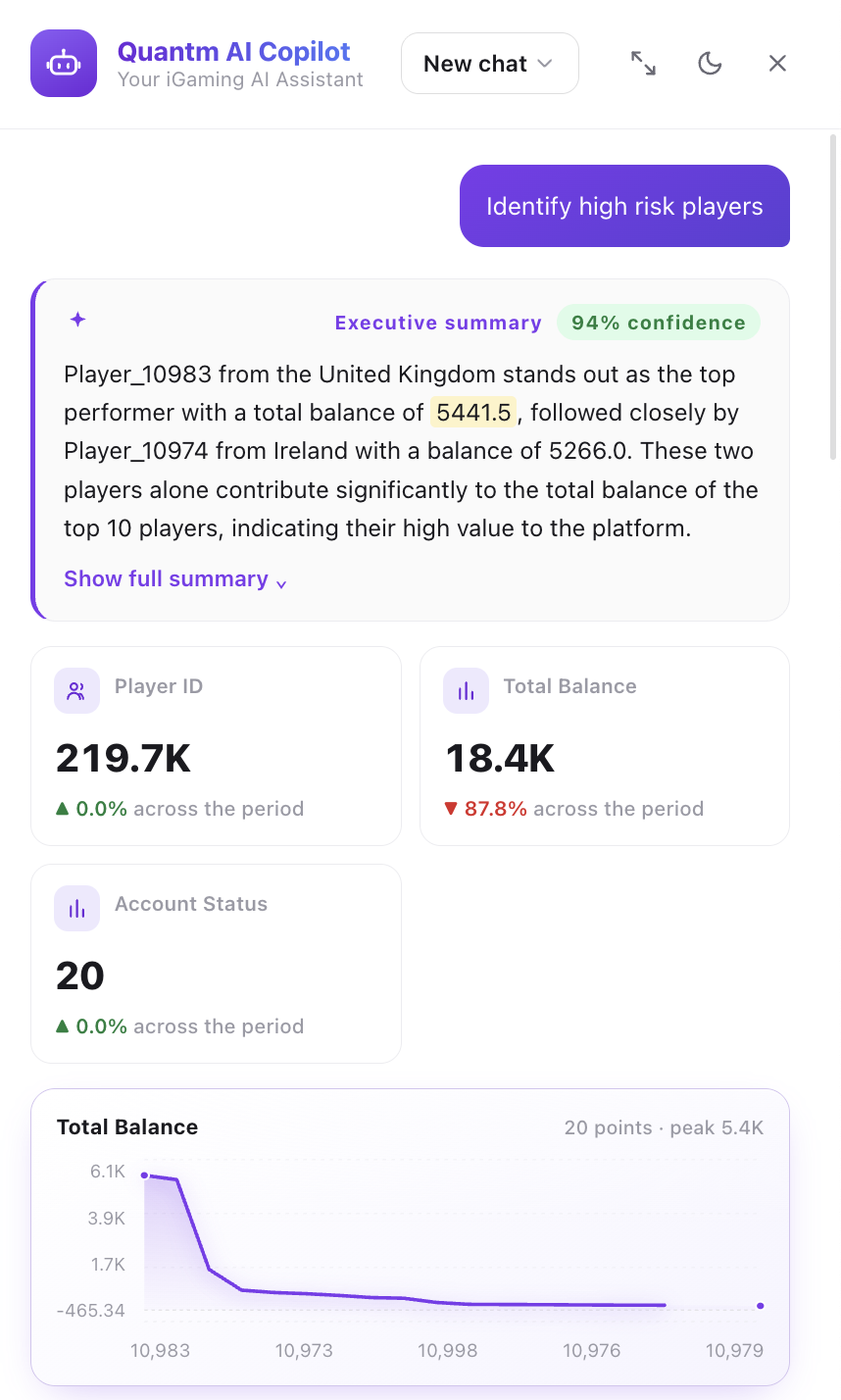
Risk analysis considers signals including shared addresses, deposit patterns and account velocity.
Such indicators can help teams prioritise investigations. They do not prove fraud. Accounts may share an address for legitimate reasons, while a sudden change in activity may have an ordinary explanation.
Risk teams should combine analytical signals with verification records, transaction evidence and established review procedures before making consequential decisions.
How Quantm AI Fits Into Smarter Decision-Making
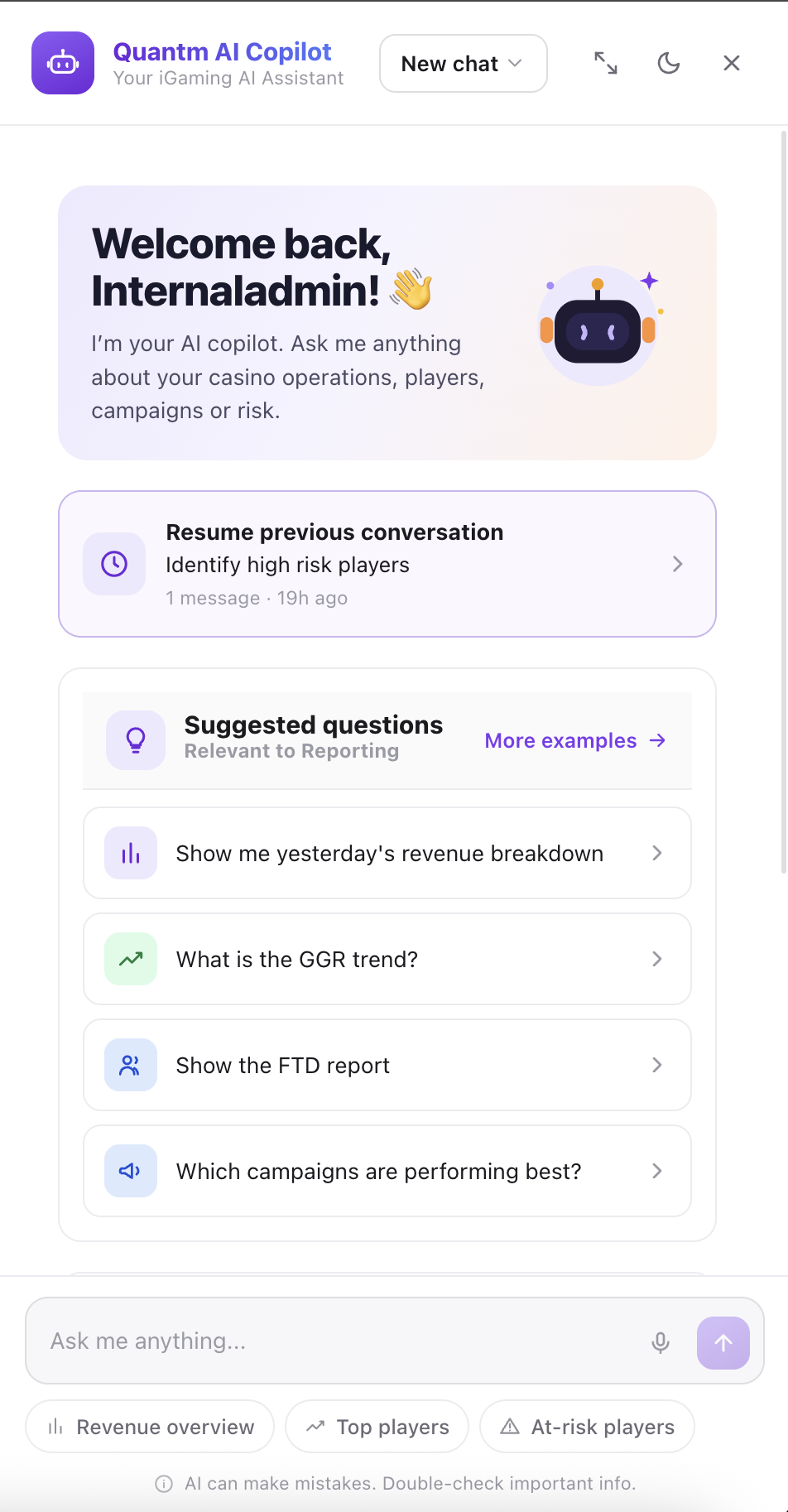
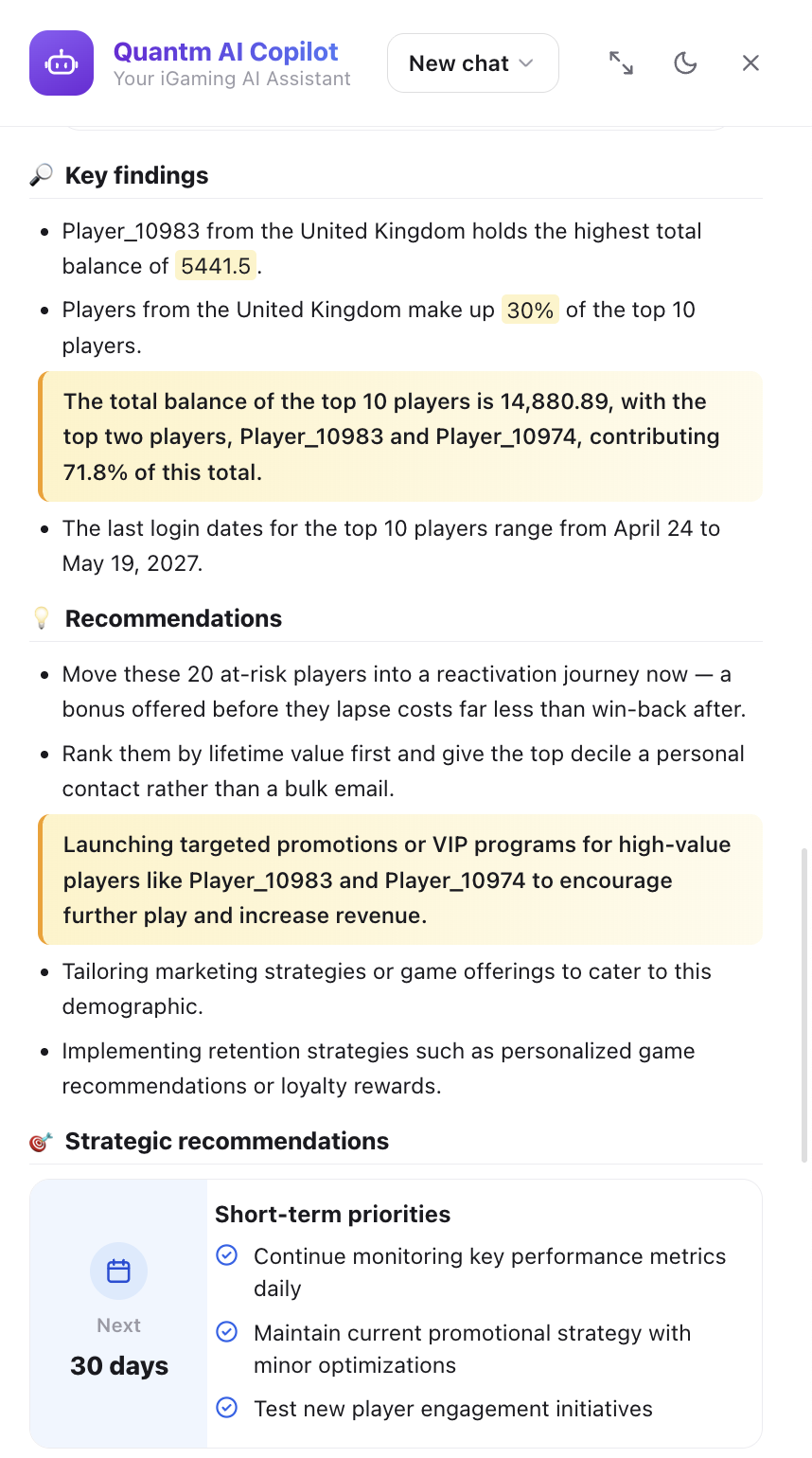
Quantm AI Copilot operates within the existing Quantm back office. Operators can ask questions in plain English and receive summaries, KPI cards, charts, tables and recommendations.
The panel uses the current page and selected filters to provide context. This helps an operator move from a transaction question to relevant analysis without first assembling multiple exports.
Its forecasting process deserves particular attention. Candidate models are evaluated against 21 days of historical data held back from model development. Several models compete, including a simple historical-average baseline, and the selected approach is rescored on each run.
Forecasts display a 95% range around projected daily revenue. This communicates uncertainty; it should not be interpreted as 95% forecast accuracy.
Forecast ranges are also distinct from confidence scores accompanying answers. Operators should understand what each measure represents before using it in a budget decision.
For teams evaluating Digient's casino software solutions, these capabilities provide concrete questions to explore during a walkthrough.
Turning a Prediction Into an Operational Decision
Consider this hypothetical example, rather than a Digient customer case study. An operator preparing next week's campaign budget wants to avoid committing spending that a weaker revenue period may not support.
- Business questionWhat revenue range should we consider when setting next week's budget?
- Relevant dataThe team reviews daily GGR history, recent performance and the forecast's selected dates.
- Predictive insightThe forecast suggests a softer midweek period, with a range around each daily estimate.
- Human reviewFinance and operations check upcoming events, scheduled maintenance and unusual historical results.
- Appropriate actionThe team evaluates a conservative spending scenario and sets a review point before further commitments.
- Outcome measurementAfter the week ends, it compares actual revenue with the forecast and reviews campaign contribution.
The prediction provides a planning input. The team remains responsible for interpreting it and choosing an action.
What Operators Need for Useful Predictive Analytics
Useful predictive analytics in iGaming starts with a clearly defined question and dependable data.
Consistent and Representative Data
Teams need consistent definitions for deposits, active players, campaign costs and revenue. Missing records, duplicated accounts or currency inconsistencies can distort results.
Historical data should represent the operation being forecast. An exceptional event may be a poor guide to an ordinary week.
Clear Outcomes and Validation
"Improve retention" is too broad for evaluating a model. Operators need to define inactivity, the prediction period and what counts as a correct flag.
Forecasts should be tested against outcomes unavailable during development. Held-back testing provides a starting point, alongside questions about performance across periods and player segments.
Monitoring and Human Oversight
Patterns change. A forecast that worked previously may become less useful after a market launch or a shift in player behaviour.
Teams should monitor errors and false positives, investigate unexpected changes and assign responsibility for reviewing recommendations. A suggested action should pass the same business checks as an action proposed by an analyst.
Privacy and Responsible Use
Copilot uses read-only queries against the operator's reporting database, with conversations stored privately against each back-office user.
Operators should verify permissions, access controls, retention settings and deployment arrangements. Outputs must respect communication preferences, account restrictions and responsible gaming safeguards.
Measuring Whether Predictive Insights Are Helping
Operators need to assess whether a forecast is useful and whether decisions based on it improve outcomes.
- Forecast error compares projected and actual revenue.
- Range coverage checks how often outcomes fall within forecast intervals.
- Flag precision measures how many flagged cases meet the defined condition.
- Missed cases identify relevant outcomes the model failed to flag.
- Campaign uplift compares eligible contacted players with a suitable comparison group.
- Planning accuracy reviews staffing, spending and capacity decisions.
An accurate churn prediction does not establish that a campaign prevented churn. Campaign GGR should not automatically be credited entirely to the campaign, because some players may have returned without receiving a message.
Good iGaming business intelligence evaluates the prediction, intervention and commercial outcome separately.
Frequently Asked Questions
What is predictive analytics in iGaming?
It uses historical and recent operational data to estimate future outcomes, such as revenue patterns or possible player inactivity. Results support planning and investigation.
How is predictive analytics different from standard reporting?
Reporting summarises recorded activity. Predictive analytics estimates what may happen next. Operators use reporting to understand the starting point and predictions to evaluate future scenarios.
Can predictive analytics help identify potential player churn?
Yes. Changes in activity can identify accounts for review. Quantm AI Copilot supports churn scoring, but a flag requires interpretation before contact or intervention.
Does predictive analytics guarantee better business results?
No. Results depend on data quality, model performance, changing conditions and team decisions. Predictions provide evidence for consideration, rather than guaranteed outcomes.
What should operators ask when evaluating predictive analytics?
Ask which outcomes are supported, what data is required, how predictions are validated and how uncertainty is displayed. Confirm permissions, review workflows and how effectiveness will be measured.
Explore Predictive Insights With Digient
Quantm AI connects forecasting and back-office analysis with questions operators face about revenue, retention, campaign spending and risk.
Want to explore how predictive analytics could support your iGaming operations? Connect with Digient to discuss Quantm AI and your business requirements.
Book a Demo