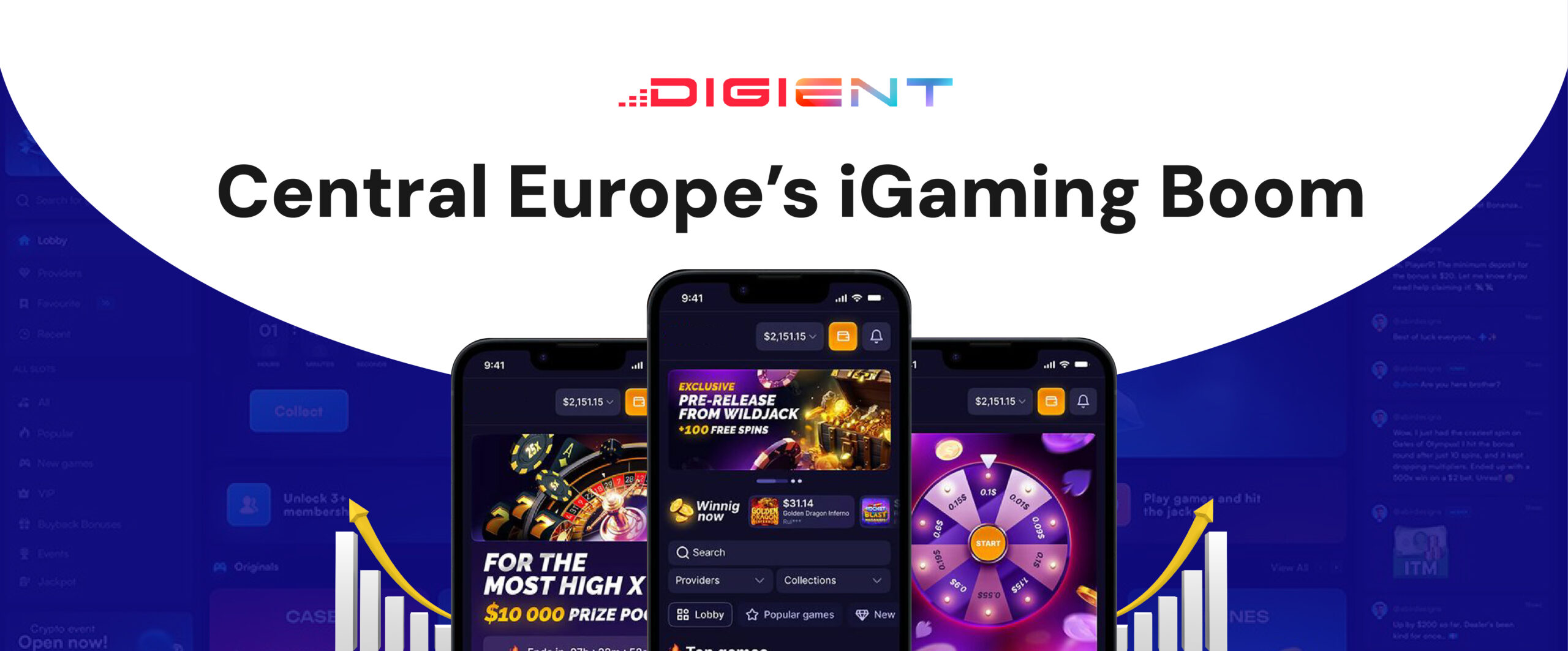
Central Europe has become one of the most strategically important regions in Europe’s iGaming landscape. It sits at the intersection of large, mature economies (Germany, Austria, Switzerland) and fast-evolving, regulation-driven growth markets (Poland, Czech Republic, Slovakia, Hungary). For operators, suppliers, and investors, the region offers a rare mix of scale, improving digital adoption, and regulatory frameworks that are still actively being refined.
Across Europe, online gambling continues to expand faster than land-based gambling, with online gross gaming revenue expected at €47.9 billion in 2024 and projected to reach €66.8 billion by 2029. Europe’s total gambling revenue is expected at €123.4 billion in 2024, rising to €149.2 billion by 2029. This macro growth is reflected in Central Europe too, but with stronger variation by country due to very different licensing models, product restrictions, and enforcement strength.
What “Central Europe” means in iGaming discussions
In industry terms, Central Europe usually includes the DACH region (Germany, Austria, Switzerland) plus the V4 cluster (Poland, Czech Republic, Slovakia, Hungary). Many commercial strategies also consider neighboring CEE markets (such as Slovenia and Romania) because player behavior, payment rails, and supplier footprints overlap. This blog focuses on the DACH + V4 core, with occasional context where it matters.
Current market snapshot: digital adoption is the main growth engine
Two Europe-wide patterns are shaping Central Europe’s iGaming trajectory.
First, online is steadily gaining share of total gambling revenue, projected at 39% of Europe’s total gambling revenue in 2024, and forecast to reach 45% by 2029.
Second, mobile is the default user experience. Mobile devices are expected to account for 58% of Europe’s online gambling revenue in 2024, rising to 67% by 2029.
For Central European operators, this means product design and acquisition strategies increasingly start with mobile UX, fast payments, and responsible gaming features that work frictionlessly on a small screen.
Regulatory landscape: the defining factor in Central Europe
Central Europe is not a single iGaming market. It is a patchwork of models, ranging from liberal licensing to strict monopoly structures. Understanding regulation is the starting point for any viable market entry plan.
Germany: tightly regulated online framework with strong player protection controls
Germany’s modern online framework is driven by the Interstate Treaty on Gambling 2021 (GlüStV 2021). A key feature is the cross-provider approach to player protection. The regulator GGL also provides guidance on how deposit-limit increases can be assessed, signaling how strongly affordability and harm-prevention are emphasized in the regulated market. (GGL)
Operationally, Germany’s direction is clear: compliance, monitoring systems, and responsible gambling controls are not add-ons; they are the product. This shapes everything from UX to payments and CRM.
Austria: online casino monopoly model with reform pressure around 2027
Austria has traditionally maintained a highly centralized model, where the online market is tied closely to a limited licensing structure and state-linked incumbents. Industry coverage also highlights that upcoming licensing deadlines around 2027 are widely viewed as a potential trigger point for reform conversations. (iGB)
For suppliers and B2B providers, Austria often becomes a “watch this space” market: strong demand exists, but access depends on how the licensing framework evolves.
Switzerland: controlled access for online offerings via licensed casinos
Switzerland’s online gambling is regulated under its Gambling Act, allowing Swiss casinos to offer online gambling through license extensions granted by the Federal Council, with additional game approvals required. This creates a controlled, domestically anchored market that emphasizes supervision and consumer protection.
In practice, Switzerland tends to favor high-trust operations, clear player safeguards, and strong compliance posture. It can be attractive for long-term, brand-safe growth, but the licensing pathway is structured and selective.
Poland: state monopoly for most online casino products, with limited private exceptions
Poland is one of the most important “large population, restricted online casino” markets in the region. A commonly cited framework point is that online casino-type games are within a state monopoly, organized exclusively by the state-owned operator Totalizator Sportowy, while certain betting activities may be licensed to private operators. (Global Practice Guides)
From a commercial perspective, Poland can be strong for sports betting strategies and partnerships, while pure online casino expansion is structurally constrained.
Czech Republic: established licensing with meaningful updates since 2024
The Czech Republic has been one of the more structured, licensing-based markets in Central Europe. An amendment effective 1 January 2024 brought significant updates to the regulatory and tax framework, affecting licensing scope, enforcement measures, and other operational requirements.
For operators, the Czech market is often attractive because it supports a regulated multi-operator environment, but requires disciplined compliance execution and localized operations.
Slovakia: regulated authority-led framework and enforcement
Slovakia’s gambling sector is overseen by the Gambling Regulatory Authority (under the Ministry of Finance). The Authority was established based on Act No. 30/2019 Coll., with defined responsibilities for licensing, supervision, and enforcement.
This type of authority-led structure usually implies clearer compliance expectations, technical certification needs, and monitoring obligations for licensed entities.
Hungary: sports betting liberalization trend, casino controls remain stricter
Hungary is often discussed as a market where certain verticals have opened more than others. Commentary on recent changes highlights that online sports betting was opened to private operators from the EEA, while online casino remains more controlled and tied to land-based concessions.
For operators, this creates a split strategy: sportsbook-led entry may be more feasible than casino-first expansion.
Product mix and player preferences: what sells in Central Europe
Across Europe, online casino is the largest contributor to online gambling revenue at €21.5 billion (2024), followed by sports and events betting at €13.7 billion (2024). Central Europe broadly follows this pattern, but with country-level variation driven by regulation.
Germany’s environment pushes operators toward compliant, regulated formats and careful game design. Poland’s structure skews commercial focus toward betting rather than broad online casino. Switzerland and Austria favor controlled, domestically anchored models.
Two product directions are especially important in Central Europe today:
- Sports betting remains a major acquisition gateway, especially around football and local leagues.
- Live casino and high-quality casino UX are retention engines where regulation allows, particularly in DACH markets.
Key trends shaping Central Europe iGaming in 2026
1. Compliance-led product design
Central Europe is increasingly “regulation-shaped.” Deposit limits, verification standards, game rules, and marketing restrictions influence how product teams build onboarding, payments, promotions, and even session flows. Germany is the clearest example of this direction, with regulator guidance reflecting a strong focus on player protection in limit-setting.
2. Stronger enforcement against unlicensed operators
More regulators are moving from “rules on paper” to active enforcement measures, including domain blocking, payment blocking, and blacklists. This is visible across multiple European markets and is increasingly relevant for Central Europe’s channelization goals, even if effectiveness varies by country.
3. Mobile-first acceleration and lightweight UX
With Europe’s mobile share already dominant and trending upward, operators that still treat mobile as a secondary channel will lose. The winners are optimizing for faster registration, fewer steps to first deposit, and responsible gaming tools that are easy to find and use on mobile.
4. Payments localization and trust signals
Central Europe has diverse payment preferences. Operators that localize payment methods, currencies, and verification flows typically outperform generic launches. Trust signals matter too: local language support, transparent withdrawal policies, and visible licensing details strongly influence conversion.
5. Safer gambling and responsible gaming as a competitive advantage
Across Europe, responsible gambling is becoming both a compliance requirement and a brand differentiator. Markets with stricter rules push innovation in reality checks, affordability checks, risk scoring, and customer interventions. Germany’s player-protection architecture is often cited as a leading example of this regulatory direction.
Opportunities and strategic playbooks
Central Europe rewards operators who match strategy to regulation.
- DACH strategy: compliance-first operations, high-trust branding, premium UX, strong RG tooling, and long-term retention over aggressive short-term bonus tactics.
- V4 strategy: localized acquisition, strong sportsbook positioning, and adaptable platforms that can respond quickly to rule changes (especially around licensing, tax, and marketing).
- Supplier strategy: offer modular technology that can be configured per country: KYC, AML, deposit limit logic, self-exclusion, reporting, and responsible gaming triggers.
Challenges to plan for
Central Europe also has real friction points:
- Regulatory fragmentation: country-by-country differences require operational complexity.
- Tax and marketing constraints: can compress margins and reduce acquisition reach.
- Grey market competition: in some jurisdictions, illegal operators still attract demand due to product freedom and promotions.
- Data, reporting, and certification overhead: especially where technical compliance and auditing requirements are strict.
What success looks like in Central Europe in 2026
Operators winning in Central Europe are doing three things consistently:
- Treat regulation and responsible gaming as core product features, not compliance checkboxes.
- Build mobile-first experiences with localized payments and low-friction onboarding.
- Use modular platform architecture so they can adapt quickly across Germany, Austria, Switzerland, Poland, Czech Republic, Slovakia, and Hungary without rebuilding everything from scratch.
Looking to Enter or Expand in the Central Europe iGaming Market?
Expanding into the Central Europe iGaming market requires more than just a platform. It demands regulatory-ready technology, localized payment integration, mobile-first design, and scalable architecture tailored to each jurisdiction. Digient helps operators navigate this complexity with secure, compliant, and high-performance iGaming solutions built for long-term growth.
If you are planning to enter or strengthen your presence in Central Europe, connect with Digient’s experts today. Schedule a consultation call to discuss your market strategy and discover how our technology-driven approach can accelerate your expansion.
 EN
▼
EN
▼
 FR
FR
 JP
JP
 KR
KR
 PT
PT
 RU
RU
 ES
ES