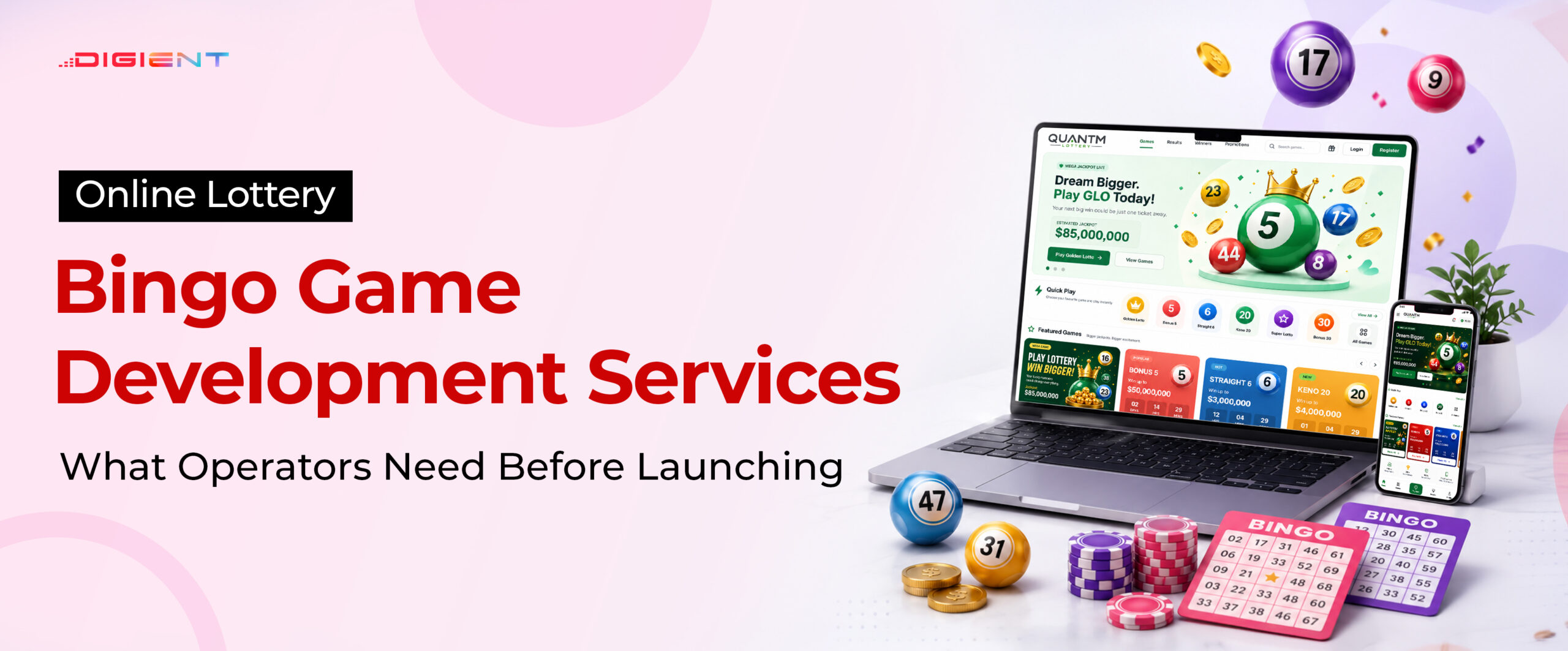
The lottery business is undergoing its most significant technological transformation in decades. From state commissions modernising legacy mainframes to emerging-market startups launching mobile-first platforms, one question dominates every procurement conversation: What must a lottery platform actually deliver?
After surveying operator discussions across North America, Europe, and Asia-Pacific, seven themes emerge consistently. Let’s walk through each one with the data to back it up.
1. Simple, intuitive UI/UX is non-negotiable
The first thing operators ask when evaluating a platform is deceptively simple: “Can our players figure it out in under 30 seconds?” With over 80% of users now accessing lottery platforms on smartphones, a clunky or overcrowded interface is a revenue killer. The best platforms offer clean ticket-purchase flows, one-tap entry to syndicate pools, real-time draw countdowns, and instant win notifications all without requiring a tutorial.
Operators also want the backend to be equally intuitive. Managing draw schedules, prize tables, and promotional banners should not require an IT department. A well-designed content management layer, built into the platform, lets marketing and operations teams move quickly without raising a ticket.
Stat: 60% of users globally now prefer digital lottery platforms over retail channels, according to 2025 market research making UX design a direct revenue driver, not a cosmetic choice.
2. Powerball, Keno, Standard Lotto Variety Sells
No operator wants to be locked into a single game format. Choosing the right lottery game development company matters here more than anywhere else the platforms winning new contracts in 2025 and 2026 support a broad game library out of the box: draw-based lotteries (Powerball-style multi-state jackpots, 6/49 Standard Lotto), Keno with rapid draw cycles, instant-win scratch cards, and raffle-style syndicate games. Draw-based formats still dominate, accounting for nearly 48% of all software deployments globally, but instant-win and Keno segments are growing fastest in mobile-first markets.
Critically, operators need the ability to configure new game variants matrix size, ticket pricing, draw frequency, rollover rules without custom development. White-label flexibility with a configurable game engine is now a baseline expectation, not a premium feature.
Stat: The draw-based lottery segment held the largest market share at over 48% in 2025, but mobile Keno and instant-win games are the fastest-growing segments by player acquisition.
3. Security and data protection are deal-breakers
A lottery platform that cannot prove it is secure will not get a licence full stop. When evaluating any lottery software provider, operators assess several security dimensions: end-to-end encryption of all transactions, PCI-DSS compliance for payment data, GDPR or equivalent data-localisation controls, multi-factor authentication for player accounts, and real-time fraud detection powered by AI. The 2024 launch of Dusane Infotech’s blockchain-integrated platform, which reduces fraud risk through immutable transaction records, signals where the industry is heading.
In 2024 and 2025, Brazil, Indonesia, and the Philippines each introduced or updated regulatory frameworks that explicitly require operators to deploy government-approved software with real-time monitoring capabilities. Security is no longer a technical specification buried in an RFP, it is the headline requirement.
Stat: Security systems are integrated into 42% of lottery platforms globally, and 38% of operators cite regulatory compliance challenges as their primary barrier to software adoption.
4. RNG certification is the foundation of player trust
Random Number Generation is not just a technical detail it is the legal and reputational bedrock of any lottery operation. Operators require platforms to carry third-party RNG certification from recognised testing labs such as GLI (Gaming Laboratories International) or eCOGRA. The February 2025 launch of Smartplay International’s quantum-enhanced RNG solution, certified to GLI-33 standards, raised the bar for what “certified” means. Some European national lottery operators have also begun piloting distributed ledger-based auditing systems, allowing independent verification of draw outcomes without exposing sensitive system data.
Any platform that cannot produce a current RNG certificate from an accredited body should be removed from consideration immediately. In 2023, Scientific Games’ NextGen platform demonstrated that AI-driven analytics can reduce number-generation errors by up to 20% proof that certification and innovation are complementary, not competing goals.
5. Reporting and analytics drive smarter operations
Operator admin dashboards have evolved from simple sales reports into genuine business intelligence tools. The platforms operators favour in 2026 offer real-time sales tracking by channel and geography, player lifetime value modelling, churn prediction, draw performance analysis, and regulatory audit trails exportable in the formats local authorities require. IGT’s 2024 lottery management system launch specifically highlighted advanced analytics and reporting as core differentiators, enabling operators to make data-driven decisions across both online and retail channels.
Access controls matter as much as the data itself. Operators want tiered admin access regional managers seeing their territory, finance seeing revenue, compliance officers seeing audit logs all from a single platform without the need for external BI tools.
Stat: IGT’s cloud-based lottery solution increased operational efficiency for operators by 25%, largely driven by integrated analytics replacing manual reporting processes.
6. Marketing and engagement tools keep players coming back
Acquiring a player is expensive. Retaining one requires the platform to do the heavy lifting. Operators are prioritising platforms that include built-in loyalty programmes, personalised promotional engines, push notification management, jackpot alert systems, referral mechanics, and social sharing features. In 2023 and 2024, several major vendors introduced gamification layers live draw animations, syndicate leaderboards, milestone rewards that meaningfully increased session frequency.
AI is now central to this layer. LottoTech’s September 2024 partnership with NeuroDraw AI brought behavioural analytics and predictive modelling directly into the player engagement stack, allowing operators to serve personalised promotions based on individual playing patterns. Lottotech’s mobile-first platform targeting emerging markets reported lottery participation rate increases of up to 30% a direct result of engagement tooling, not just distribution.
Stat: AI-driven analytics have increased player participation rates by up to 20%, and mobile lottery applications now contribute to 46% of total player engagement globally.
7. Payment gateways: speed, variety, and global reach
A player who cannot complete a payment is a lost sale and lost trust. Operators demand payment gateway integrations that cover credit and debit cards, local e-wallets (GCash, Paytm, M-Pesa depending on the market), bank transfers, prepaid vouchers, and increasingly, cryptocurrency rails for crypto-native audiences. Instant deposit confirmation and fast withdrawal processing (within 24 hours at most) have become standard expectations.
Currency localisation, multi-language support, and compliance with regional payment regulations (PSD2 in Europe, RBI guidelines in India) add complexity that operators expect the platform vendor not their own team to manage. New payment gateway integrations in 2024 facilitated instant multi-currency transactions and reduced payment failure rates significantly for platforms that invested in this layer.
 EN
▼
EN
▼
 FR
FR
 JP
JP
 KR
KR
 PT
PT
 RU
RU
 ES
ES