For most of the last decade, iGaming operators grew one vertical at a time. Launch a casino, prove it out, maybe add a sportsbook a few years later once the balance sheet could support a second vendor relationship. That sequencing made sense when technology stacks were expensive to build and harder to integrate. It doesn't make sense anymore.
The operators pulling ahead in 2026 aren't the ones with the deepest casino catalog or the sharpest sportsbook odds in isolation. They're the ones running poker, casino, lottery, and sports betting off a single platform, one wallet, one KYC flow, one CRM, one bonus engine, so a player who logs in for the World Cup can just as easily stay for a poker tournament or a lottery draw without ever leaving the brand. The question for most operators now isn't whether to run multiple verticals. It's whether to do it on one iGaming platform or four separate ones that were never built to talk to each other.
Why Multi-Vertical Platforms Are Winning in 2026
A casino-only brand loses players to sportsbooks during major tournaments. A sportsbook-only brand loses off-season revenue it could be capturing in casino or lottery instead. Every vertical an operator doesn't offer is a moment where a player has somewhere else to go, and once they've deposited on a competitor's platform, winning that player back costs far more than it would have to retain them in the first place.
Running everything through a single technology partner solves a problem that's easy to underestimate until you've lived with the alternative: four vendors means four compliance reviews, four support relationships, four separate places for player data to live, and four different release schedules to coordinate around. A unified stack collapses that into one operator dashboard controlling casino, poker, lottery, and sportsbook at once.
White-Label vs. Turnkey: Which Model Fits Your Business?
This is the first real decision every operator has to make, and it shapes everything downstream: cost structure, how much technical control you retain, and how fast you can actually get to launch.
| White-Label | Turnkey | |
|---|---|---|
| What you get | A fully managed, ready-to-launch platform operated under your brand | The complete platform and source code transferred for self-hosting |
| Speed to launch | 3–5 weeks (casino/poker), 2–4 weeks (lottery) | 4–8 weeks depending on customization scope |
| Ownership | Provider manages hosting, updates, infrastructure | Operator owns and manages the technical stack long-term |
| Best for | Fast, lower-risk market entry; startups and new brands | Operators wanting complete long-term ownership and technical control |
| Compliance & licensing | Handled by the provider | Operator-managed, provider-supported |
White-label suits operators who want to move fast, stay lean, and let someone else carry the infrastructure burden. Turnkey suits operators who've decided long-term ownership is worth the extra weeks up front. Neither is objectively better, it depends on what stage the business is at, and a serious provider should offer both rather than forcing you into a model that stops fitting once you've outgrown it.
What "Best" Actually Means in an iGaming SaaS Platform
Skip the marketing checklist. The things that actually determine whether a platform makes money for an operator, rather than just looking good in a sales deck, come down to a handful of fundamentals: casino, poker, lottery, and sportsbook running on shared wallet, CRM, and bonus infrastructure instead of siloed systems; KYC, AML, GDPR, and responsible-gaming tooling built into the platform rather than bolted on after a compliance audit flags the gap; and operator control deep enough that changing a promotion or updating a game lobby doesn't require a support ticket and a two-week wait.
Underneath all of that sits infrastructure that most players never think about and most operators only think about when it fails: cloud-native architecture built to scale automatically through traffic peaks, and global payments coverage spanning fiat, crypto, and regional rails from day one, not added as an afterthought once an operator asks for it.
Poker: Built for Retention, Not Just Tables
A poker platform lives or dies on liquidity and player lifetime value, not table count. A modern poker software provider needs to deliver cash games, tournaments, and full network infrastructure, Texas Hold'em, Omaha, Omaha 5 & 6, Chinese Poker, Open Face Chinese, alongside player segmentation and LTV growth tools that come standard rather than as a paid add-on. KYC/AML and safer-gaming controls need to be part of the network from day one, not layered in after a regulator asks why they weren't.
Available as white-label poker software or a fully customizable turnkey poker platform, the goal is the same either way: keep players at the table longer, and keep the network compliant while you scale it.
Casino: Scaling Without a Content Ceiling
Content breadth is what separates a casino platform that retains players from one that quietly leaks them to a competitor with a bigger library. A modern turnkey and white-label casino solution should give operators game aggregation across thousands of titles, video slots, live dealer, crash games, progressive jackpots, backed by an AI-powered bonus engine and regional launch readiness built for fast market entry rather than a six-month rollout.
Branding needs to run deeper than a logo swap. Front-end elements like color palette, typography, lobby layout, and player UX flows should be fully configurable, and so should back-end branding: email templates, notifications, bonus naming. Done properly, the platform looks and feels like something built exclusively for the operator's brand, not a reskinned template with someone else's fingerprints still on it.
Lottery: The Fastest Vertical to Market
Lottery is consistently the quickest vertical to launch, and one of the easiest to bolt onto an existing casino or sportsbook brand without disrupting anything already live. A white-label lottery platform typically covers draw-based games, instant win, scratch cards, and access to global lottery integrations, fully mobile-optimized, with licensing and compliance handled by the provider rather than the operator. Most white-label lottery platforms go live in two to four weeks.
For operators looking for a low-lift way to add a new revenue line without opening a new compliance front, lottery is usually the fastest and least complicated path.
Sports Betting: Odds, Risk, and Real-Time Control
Sports betting rewards speed and precision in odds delivery, in risk management, and in how quickly an operator can react when a live market moves. A serious white-label or turnkey sportsbook solution needs real-time odds feeds, anti-cheat and risk-management systems, a player wallet, payments, and CRM, all pre-integrated rather than stitched together after launch, covering 50+ sports including esports and virtuals across pre-match, live, and outright markets.
Domain, logo, color theme, and UI layout should be fully configurable, and KYC, AML, GDPR, and responsible-gaming tools need to be integrated from day one so the sportsbook is compliant before it goes live, not compliant-in-progress while regulators watch.
The Business Case, By the Numbers
The global online gambling market surged past $107 billion in 2026, and sports betting alone is growing at roughly a 10.3% CAGR annually. Behind those headline figures is a more useful pattern for operators actually planning a launch: the timelines and content depth that separate a fast, well-resourced entry from a slow, thin one.
| Metric | Detail |
|---|---|
| Typical casino/poker launch timeline | 3–5 weeks (white-label) |
| Typical sportsbook launch timeline | 3–6 weeks (median 24 days across recent cohorts) |
| Typical lottery launch timeline | 2–4 weeks |
| Casino content library | 15,000+ titles across slots, live dealer, progressive jackpots |
| Sports coverage | 50+ sports, including esports and virtuals |
The pattern across every vertical is the same: the operators winning market share aren't the ones building from scratch. They're the ones launching in weeks on proven infrastructure and spending their runway on marketing and player acquisition instead of platform engineering.
Why Operators Choose Digient
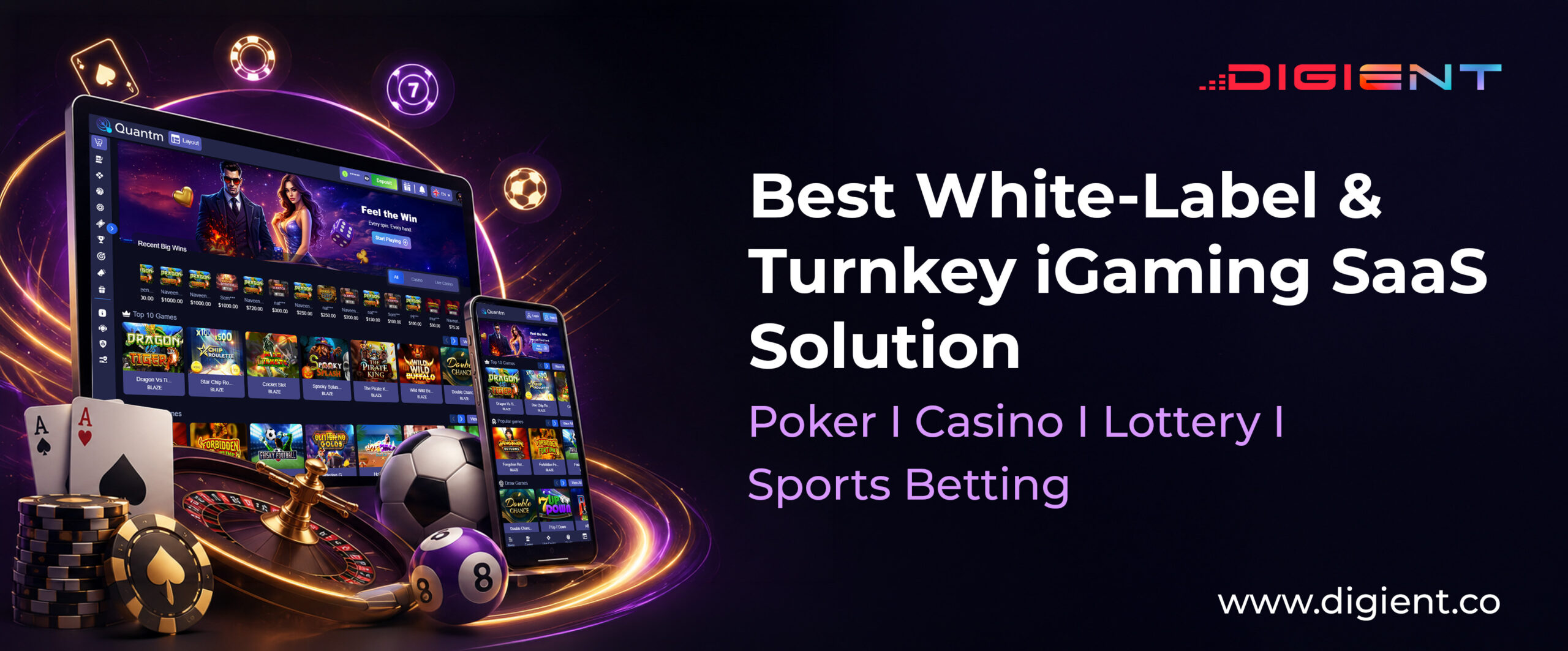
Digient delivers the Quantm AI platform, a turnkey and white-label iGaming SaaS solution spanning casino, sports betting, poker, lottery, and prediction markets, built for operators who need compliance-ready infrastructure without giving up operator control. The company has spent over 18 years focused exclusively on iGaming, which shows up less in any single feature and more in how few surprises operators run into after launch.
That focus translates into rapid deployment, live in weeks rather than the 12–18 months a custom build typically takes, and full operator control from front-end experience down to back-office configuration, with no day-to-day dependency on the vendor for routine changes. Global payments infrastructure covers multi-currency and crypto-ready rails alongside major payment methods and alternative finance options, backed by zero-downtime SLAs and real-time visibility across players, games, and revenue, with 24/7 operations support behind it. Digient's operator base already spans Europe, Asia, LATAM, and Africa, one platform, every vertical, one partner accountable for all of it.
FAQs
What is a white-label iGaming platform?
A ready-built, fully branded gaming solution that an operator can launch under their own brand without building the technology from scratch, the provider handles hosting, updates, and infrastructure on an ongoing basis.
How is turnkey different from white-label?
A turnkey solution delivers everything needed to launch, platform, games, payments, compliance, and support, with the fully built platform (and often source code) transferred to the operator for self-hosting and long-term ownership. White-label is faster and lower-risk for market entry; turnkey suits operators who want complete long-term control.
How fast can I launch a multi-vertical platform?
Casino and poker platforms typically launch in 3–5 weeks, sportsbooks in 3–6 weeks, and lottery in as little as 2–4 weeks, depending on licensing jurisdiction and customization depth.
Is the platform fully brandable?
Yes. Domain, logo, color palette, typography, lobby design, and player UX flows are fully configurable across every vertical, along with back-end branding like email templates and bonus naming.
Does the platform support crypto and multi-currency payments?
Yes. Multi-currency wallets, global payments infrastructure, and crypto-ready rails are built in, supporting operators scaling across multiple jurisdictions simultaneously.
Is compliance handled by the provider?
Yes. KYC, AML, GDPR, and responsible gaming tools are integrated across all verticals, with licensing and regulatory support built into both the white-label and turnkey models.
Can I add new verticals later without rebuilding?
Yes. Because casino, poker, lottery, and sportsbook run on shared wallet, CRM, and bonus infrastructure, new verticals can be added to an existing brand without a separate technology stack or a second integration project.
Ready to launch poker, casino, lottery, and sports betting under one brand?
Talk to Digient's Team